Card stock and label guidelines
Card stock and label weights support
The following media types are supported only in Lexmark MS725 and MX725 printer models.
-
Vinyl and polyester labels
-
Narrow media batch jobs
The following table lists the maximum weights supported by the trays and the multipurpose feeder.
|
Paper source |
Card stock1 |
Labels |
|||||
|---|---|---|---|---|---|---|---|
|
Index Bristol |
Tag |
Cover |
Paper |
Dual‑web paper |
Polyester |
Vinyl |
|
|
Standard and optional 550‑sheet trays |
199 g/m2 (110 lb) |
203 g/m2 (125 lb) |
176 g/m2 (65 lb) |
180 g/m2 |
180 g/m2 |
220 g/m2 |
300 g/m2 |
|
Multipurpose feeder 2 |
199 g/m2 (110 lb) |
203 g/m2 (125 lb) |
176 g/m2 (65 lb) |
180 g/m2 |
180 g/m2 |
220 g/m2 |
260 g/m2 |
1 See for specific recommendations Grain orientation.
2 Due to label design characteristics, unacceptable feeding may be experienced from the multipurpose feeder.
|
Labels |
Thickness |
0.102–0.305 mm (0.004–0.012 in.) |
|
Smoothness |
100–400 Sheffield* |
* 150–250 Sheffield is optimal. Using media higher than 300 Sheffield could result in printing degradation.
Labels are one of the most difficult print materials for laser printers. Use a special fuser cleaner for label applications to optimize feed reliability and prevent duplexing.
It is recommended that you install the fuser oil cleaner, P/N 40X8579, when you run labels. When you order a new cartridge, make sure that it includes the correct fuser wiper.
It is possible to duplex certain labels that have been specifically designed for this application. To duplex labels, consult the Lexmark converter lists to see which converters have successfully developed this type of label. You must install the wax wiper, P/N 40X8581. Cartridges designed for duplex label printing contain two wax wipers. Change the wax wiper at the halfway point of your normal cartridge usage to provide extra cleaning and optimize performance. Contact your supplies and label specialist for information on oil and wax vinyl label cartridges.
Tray fill line information
Depending on construction, labels and card stock can sometimes be difficult to pick and feed reliably. Performance can be improved by controlling the number of sheets of media loaded in the tray. There are two fill lines in the tray. The solid line is the maximum paper fill indicator. No media should be loaded in the tray above this line or paper jams could occur. The dashed line is the alternate paper fill indicator and should be used if any feed or reliability issues are noted with specialty media, including labels and card stock. If paper jams occur when completely filling the tray, load the specialty media only up to the alternate paper fill indicator.
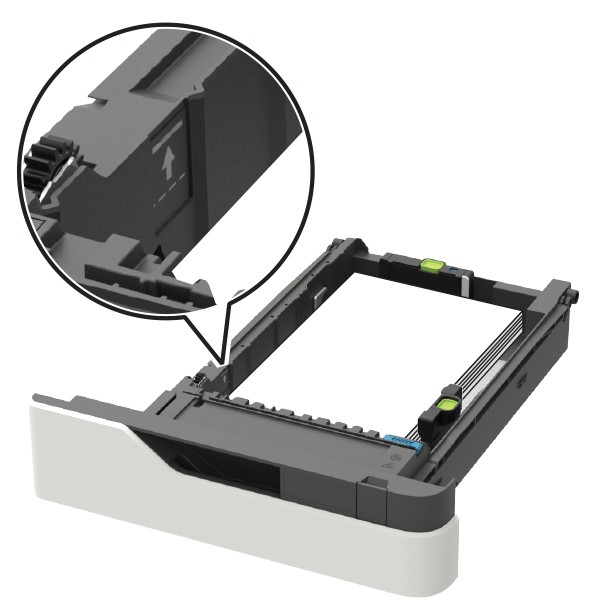
For more information on the printer models and feeding different types of media, contact your Lexmark sales representative.
When printing on labels:
-
From the control panel, set the paper size, type, texture, and weight in the Paper menu to match the labels loaded in the tray.
-
Do not load labels together with paper or transparencies in the same tray. Combining print materials can cause feeding problems.
-
Use full label sheets. Partial sheets may cause labels to peel off during printing, resulting in a paper jam. Adhesive material may contaminate your printer. It could also void your printer and cartridge warranties.
During printing, the number of labels per sheet can affect registration more than basis weight. Typically, the more labels per sheet, the better the registration.
When printing on card stock:
-
From the control panel, set the paper size, type, texture, and weight in the Paper menu to match the card stock loaded in the tray.
-
Do not use card stock that is creased. It may cause paper jams.
For more information, see the following: